
Feature Article - A head for heights
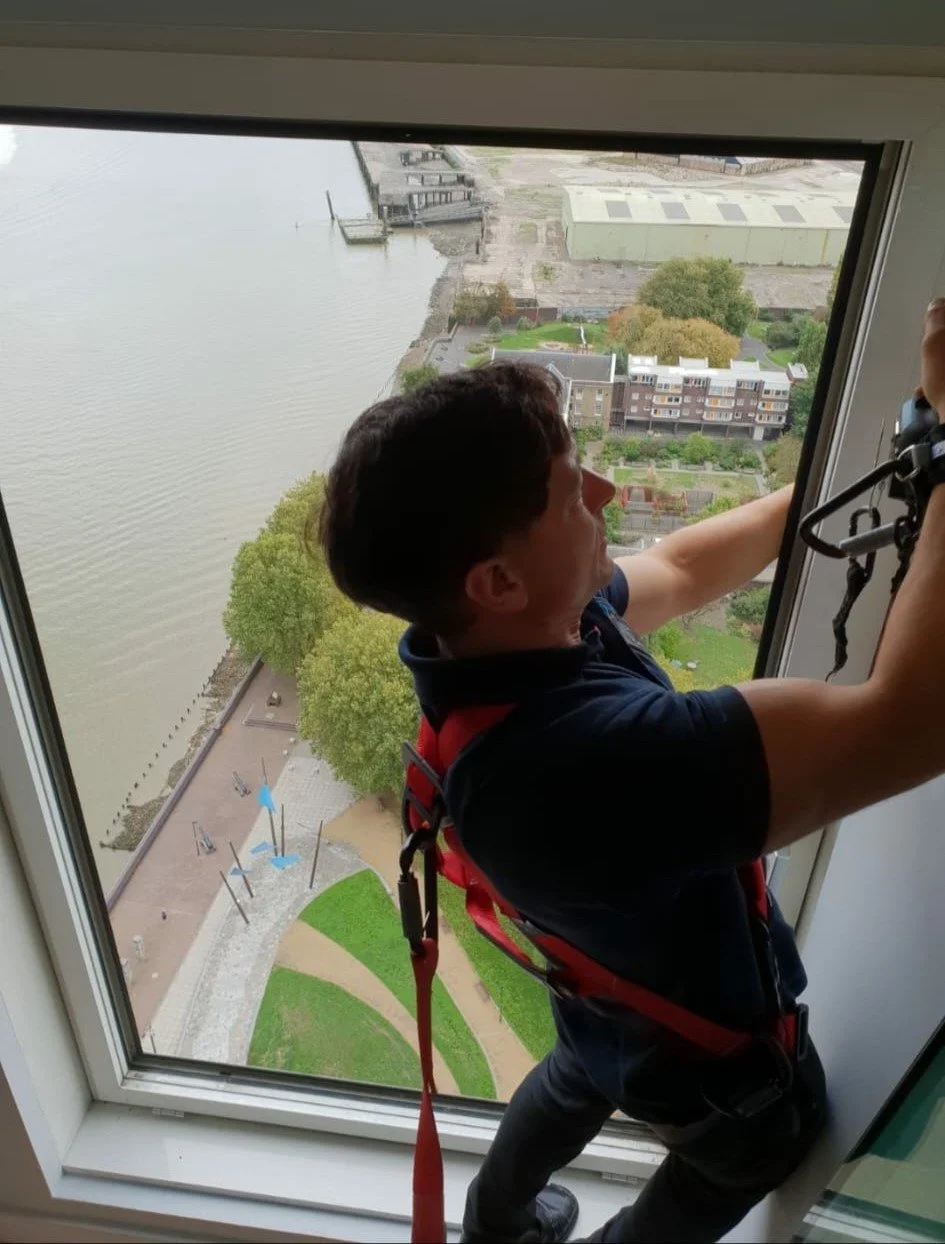
Innovator Daniel Cheddie, founder of Glazesafe and the multi-award winning Sashmate®, discusses why Stronghold® is transforming installation safety when working at height.
Daniel, can you tell us how you got started in the fenestration industry and what led you to safety innovation in particular?
I started in the glazing industry at 19 working on window repairs and replacements and that gave me a real understanding of the everyday challenges installers face, especially around access and safety. Back then, scaffolding was often too expensive, and the alternatives were usually either unsafe or made the work harder.
I’ve always enjoyed solving problems, maths, engineering, visualising how something could work better, and over time I started to apply that mindset to the issues I saw on-site.
At the same time, I’ve also spent over 20 years as a full-time firefighter, so safe working at height is something I’ve lived daily. That dual experience as a tradesman and as someone trained in risk management and rescue naturally led me toward innovating in the safety space.
Stronghold® is the latest in a line of solutions you’ve developed for working at height; can you share the story behind the concept?
It came from a conversation on a building site, as so many good ideas do. I was visiting a hospital construction project where the team was using the Sashmate®. The director of the façade company told me their biggest challenge wasn’t repairs, but safe installation at height when there’s no scaffolding or anchor points. That stuck with me. I'd heard similar stories before, installers anchoring themselves to radiators or even bed frames to get a window in. I knew there had to be a better way.
The concept for Stronghold® was born there and then: a simple but solid internal frame that creates secure anchor points and can be set up quickly inside the building. I even spoke to a physics professor at the University of Hertfordshire to help get the formula right.
Stronghold® had to be lightweight, adjustable, easy to set up, but incredibly strong. The challenge was finding the right materials and designing it in a way that made sense for installers.
Explain what Stronghold® is, how it works, and what makes it different from traditional methods like scaffolding?
Stronghold® is a portable anchoring frame that allows engineers to work safely at height without the need for external scaffolding or fixings.
It’s assembled inside the building in under 10 minutes and creates secure, tested anchor points for harnesses and barrier protection. There’s no drilling, no fixing, no damage to the structure, and no reliance on access from outside.
It’s lightweight and folds down to fit easily in a van, leaving room for glass and tools. It can be carried and set up by a single fitter, which is a huge time and cost advantage over towers or scaffolding. And because it’s tool-free and reusable, it reduces setup time and eliminates delays waiting on third-party access equipment.
You’ve said Stronghold® isn’t a replacement for scaffolding, but a smarter, specialist alternative. In what types of situations is Stronghold® a game-changer for installation companies?
Exactly, it’s not about replacing scaffolding, it’s about having the right tool for the job. Stronghold® shines in situations where scaffolding is overkill, impractical, or not permitted.
High-rise jobs where you’re replacing a single window on the 20th floor, properties with tight or awkward access, emergency callouts where time is critical. And increasingly, in cost-sensitive projects where scaffolding alone would cost more than the actual installation. That flexibility means installation companies can say “yes” to more jobs.
The recent updates to Stronghold® seem like a big step forward. What are they and what kind of impact will they have for installation businesses?
Stronghold® can now span 5m, up from 3.7m previously, so it can now be used on larger openings, and it can now support three engineers operating simultaneously instead of two, meaning bigger jobs can get done faster.
For businesses, that translates directly into reduced labour time and increased profit margins, and it means they can take on more complex, higher-value projects without the cost and logistical delays that scaffolding brings.
Looking ahead, how do you see systems like Stronghold influencing the future of working at height in the fenestration sector?
We’re already seeing a shift. Since Grenfell, regulations like CDM (Construction Design and Management) have become stricter, with clients now expected to demonstrate safe planning for every stage of a build or installation. Stronghold helps meet those obligations and not just safely but affordably.
Long-term, I see Stronghold becoming a standard option in tenders, especially for councils, housing associations, and contractors who need fast, safe access for targeted works.
More than anything, it gives business owners and fitters a professional a great USP to say they will do the job safely, in days not weeks, and save the client thousands. That changes everything.